The Best Free Encounter Generators (2026 Edition)
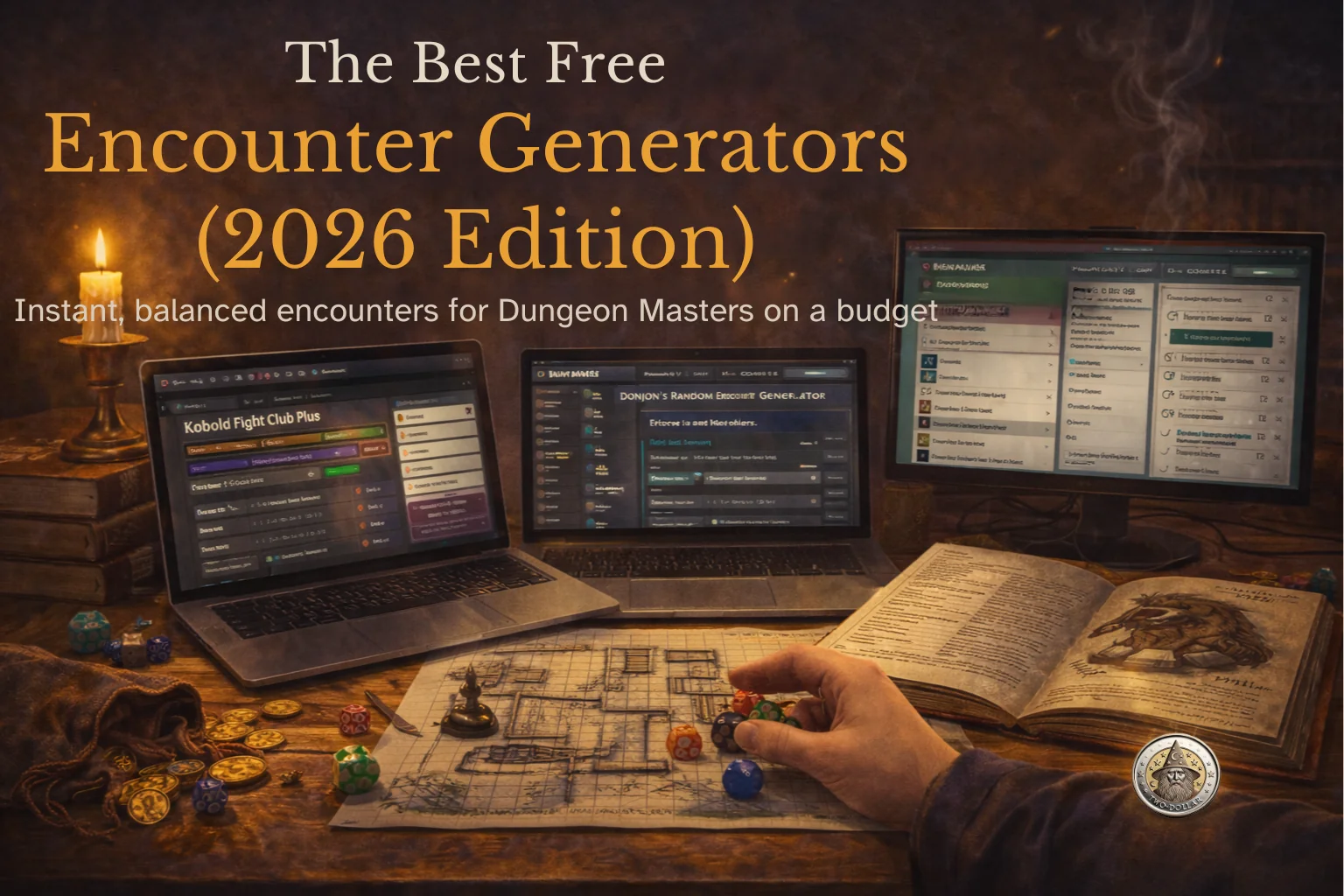
We've all been there. It's 7:45 PM, your group logs on in fifteen minutes, and you suddenly remember you didn't prep anything for when they inevitably wander off into the forest instead of following your carefully planned plot hook. You need an encounter. You need it now. And you definitely don't have time to crack open the Monster Manual and do math.
After 30+ years of running games (and countless panic-prep sessions), I've tested dozens of encounter generators. Most are fine. Some are garbage dressed up with pretty interfaces. But a handful have genuinely changed how I prep, and they haven't cost me a dime. Here are the ones that have earned permanent spots in my DM toolkit.
Kobold Fight Club Plus: The Gold Standard
Let's start with the one that probably saved more sessions than any other tool I use.
Kobold Fight Club Plus (the "Plus" is important, the original site is basically abandoned) does one thing exceptionally well: it tells you whether your encounter will actually be fun or whether you're about to accidentally kill everyone before the pizza arrives.
You punch in your party size and levels, then browse or filter monsters by CR, environment, or creature type. The site calculates encounter difficulty in real time. Easy. Medium. Hard. Deadly. It even accounts for the action economy, which is something a lot of DMs (including past me) forget matters way more than raw CR numbers.
Where it really shines is when you're building multi-creature encounters. Drag in four goblins and a hobgoblin captain, and the calculator instantly adjusts. Want to see what happens if you add a worg? Click, recalculate, done. The filtering system lets you narrow by environment too, so if your party is trudging through swamp, you're not wading through frost giants to find something appropriate.
I use this at least once per session, usually during the session itself when players do something unexpected. It's fast enough that I can build a balanced encounter while pretending to read my notes dramatically.
Find it at: koboldplus.club
Kassoon: The Modern Swiss Army Knife
If Kobold Fight Club is a precision tool, Kassoon is the entire hardware store. This site has been steadily adding features for years, and their random encounter generator is legitimately impressive.
The interface actually looks like it was designed in this century, which is more than I can say for some of my favorite tools. You select your party level, the environment, and how difficult you want things to be. Hit generate, and it spits out a complete encounter with monster stat block summaries, suggested tactics, and even terrain features.
But here's what sets Kassoon apart: the encounters feel like they have stories. You don't get "3 wolves attack." You get wolves that are protecting a wounded pack member, or hunting the same deer the party was tracking, or acting strangely because of a nearby corruption source. These little narrative hooks transform forgettable fights into sessions your players will actually remember.
The site also includes a combat tracker that remembers stuff between sessions. For DMs running long campaigns, that's genuinely useful. I've started prepping entire sessions using their session planner feature, then importing encounters directly into the tracker.
Find it at: kassoon.com/dnd
Donjon: The Old Reliable Workhorse
Donjon looks like it was designed in 1999. Because it probably was. Don't care. It's POWERFUL.
While the other generators on this list focus on balanced, thoughtful encounters, Donjon takes a different approach. You tell it what you want, and it generates everything. Random dungeon with fully keyed rooms and a map? Done. Complete treasure hoard with specific magic items? Done. Weather for your hex crawl? Done. A name for that NPC you forgot to prep? Done in twelve different cultural styles.
The encounter generator specifically is more bare-bones than Kassoon or Kobold Fight Club. It gives you monsters appropriate to the environment and challenge level, but it won't write narrative hooks for you. What it will do is generate encounters fast, which makes it perfect for sandbox campaigns where you need lots of options ready to go.
I keep Donjon open in a browser tab during every session. When players ask "what's the weather like?" or "are there any other travelers on the road?" or "what does the bartender's name tag say?", Donjon has my back. The name generator alone has saved me thousands of times.
Find it at: donjon.bin.sh
5e.tools Encounter Builder: The Reference Companion
If you're already using 5e.tools for rules reference (and if you're not, what are you doing?), their built-in encounter builder deserves attention.
The encounter generation here integrates with their complete bestiary, which means you get full stat blocks right in the interface. Build your encounter, click a monster, and every ability, action, and legendary resistance is right there. No switching tabs, no fumbling through books.
The filtering is comprehensive. CR, size, type, environment, alignment, source book, legendary status. You can get hyper-specific. Need a CR 5 aberration from a swamp that appears in Mordenkainen's? Three clicks. The search function is blazing fast, which matters when you're hunting for something specific during play.
What I particularly appreciate is how it handles encounter difficulty differently than Kobold Fight Club. It gives you the standard difficulty ratings, but also shows adjusted XP thresholds based on monster special abilities. A CR 3 creature with pack tactics and multi-attack hits different than a CR 3 creature with nothing but a basic melee attack, and this tool acknowledges that.
Find it at: 5e.tools (look for "Encounter Builder" in the DM Tools menu)
Eigengrau's Generator: When You Need More Than a Fight
Sometimes the encounter you need isn't combat. Sometimes you need a strange tavern full of interconnected NPCs, a traveling merchant with suspicious cargo, or a festival that might turn violent if your players keep rolling nat 1s on their persuasion checks.
Eigengrau's Essential Establishment Generator creates entire locations populated with characters who have relationships, secrets, and motivations. You're not generating an encounter so much as generating a situation that might become several encounters depending on what your players do.
Click once and you get a tavern with a name, a description, a bartender with a backstory, several patrons with their own stories, and enough detail to run an entire session. The NPCs know each other. They have opinions about each other. Some of them are up to something.
This won't help you when you need three goblins in a hurry. But when your players decide to spend the entire session in town instead of going to the dungeon you prepped, Eigengrau's gives you somewhere to take them.
Find it at: eigengrausgenerator.com
How I Actually Use These
Here's my workflow for encounter prep, which has evolved over years of experimentation and failure.
During session prep, I use Kassoon to build two or three "just in case" encounters appropriate to wherever the party might wander. The narrative hooks help me integrate them into whatever story is developing. I save these to their combat tracker if I think I'll actually use them.
During play, Kobold Fight Club stays open for quick difficulty checks and improvised encounters. If players do something unexpected and I need to throw something at them, I can balance an encounter in about thirty seconds.
Donjon handles everything else. Names, weather, treasure, random details. It's the glue that makes improvisation feel prepared.
5e.tools is my rules reference, and when I need a monster stat block fast, the encounter builder is already right there.
Eigengrau's comes out when the session is going in an unexpected direction and I need a location that feels real. Players deciding to investigate that village I mentioned once in passing? Give me ninety seconds with Eigengrau's and suddenly that village has a blacksmith with a gambling problem and a baker who's secretly funding the local bandits.
The Real Secret
None of these tools will make you a good DM. They won't write your story or make your players care about the world. What they will do is handle the mechanical heavy lifting so your brain is free for the parts that actually matter: responding to your players, adapting to unexpected choices, and building collaborative stories that everyone at the table creates together.
The time you save not doing encounter math is time you can spend making that encounter memorable. A balanced fight against bandits is forgettable. A balanced fight against bandits who turn out to be former soldiers from a war your player's character fought in? That's a session your table will talk about for years.
These generators don't replace creativity. They enable it by clearing the tedious stuff out of the way. Use them, and spend your precious prep time on the parts only you can provide.
Got a favorite encounter generator I missed? Hit me up. I'm always hunting for new tools to add to the arsenal.
Resources Mentioned
Keep Reading
Ten Free D&D Resources That Make You Look Like You Did the Homework
Somewhere tonight, a Dungeon Master is staring at a blank page an hour before the session, wondering what the innkeeper's name is. Here are ten free resources that will answer that question in about four seconds.
Player Agency: Why Your Players Should Break Your Campaign
The best moments in D&D happen when players do something you never expected. Here's how to embrace the chaos.
Dyson Logos: The Free Map Legend You Should Know
Dyson Logos has released hundreds of maps for free commercial use. Here's how to find and use them in your games.