
Player Agency: Why Your Players Should Break Your Campaign
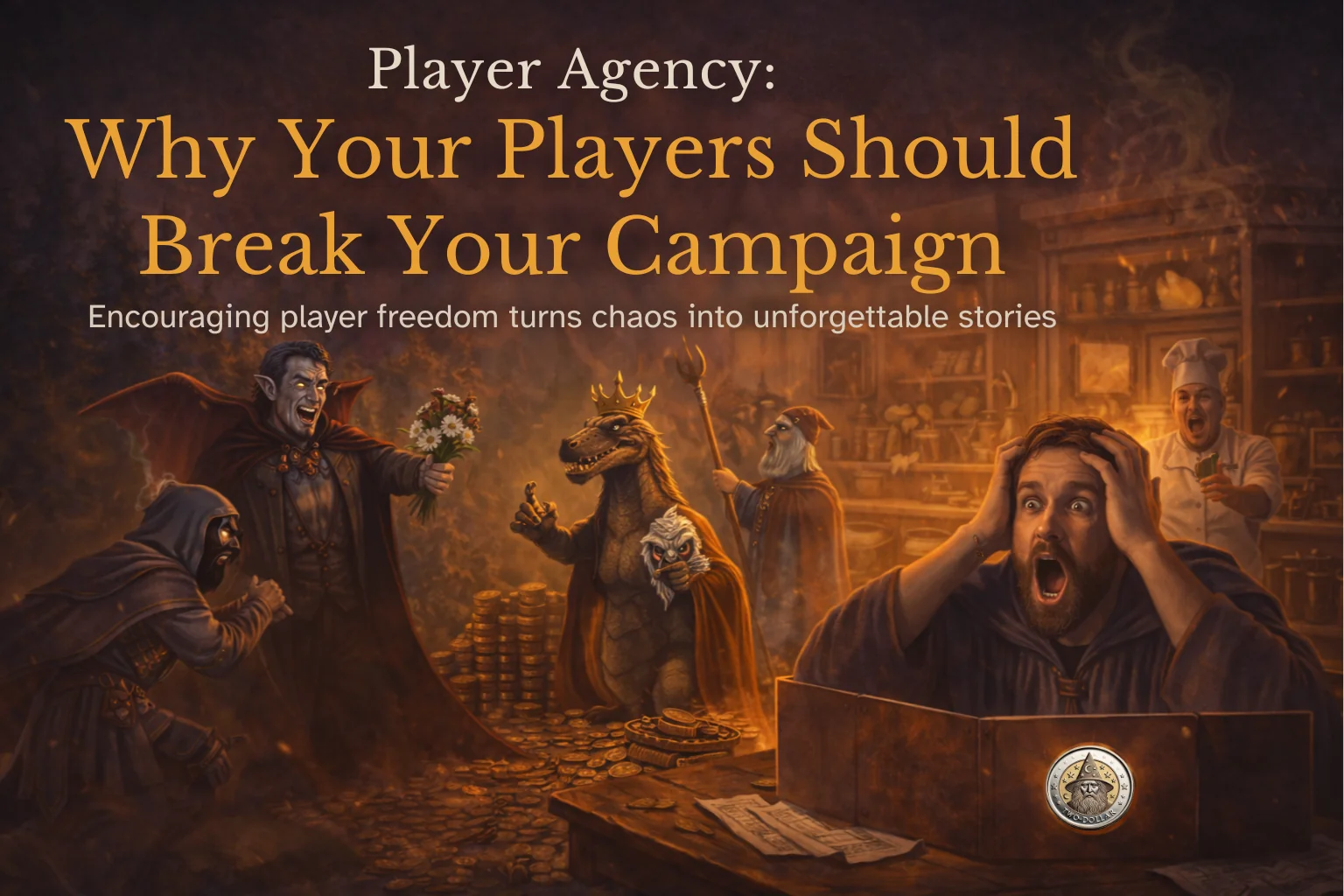
I've been running D&D games for over 30 years now, and I can tell you with absolute certainty: the campaigns I remember best are the ones my players completely derailed.
Not the sessions where they followed my carefully plotted path from Point A to Point B. Not the moments where they made the "correct" choice that led to the encounter I'd spent hours preparing. No. The campaigns that still make me smile are the ones where my players looked at my beautiful plans and said, "What if we do something completely different?"
And here's the thing I wish someone had told me decades ago: that's not a bug. That's the whole point.
The Trap of the Pre-Packaged Plotline
We've all been there. You've got your adventure ready. Maybe you spent $50 on a hardcover campaign book, or maybe you've been plotting out this story arc for weeks. Either way, you know exactly how this is supposed to go.
Then your players walk into the room and decide to recruit the demon lord instead of destroying it.
In that moment, you have two choices. You can scramble to find some way to drag them back to your pre-packaged plotline, fighting against their creativity to preserve your investment. Or you can take a breath and realize that something amazing is happening.
When I'm in that situation (and I've been in it hundreds of times), I've learned to morph the campaign to incorporate whatever ridiculous scheme my players have cooked up. Not because I'm a pushover. Because working with your players rather than against them is what transforms a game into something priceless.
The Magic of Shared Narrative
D&D is a storytelling game. A group of people telling each other a story. We lose track of this sometimes, getting too wrapped up in expensive materials and predetermined paths.
But think about it: this idea of shared storytelling is primal. It's something most of us haven't really experienced since childhood, when we had stories read to us and we could interact with them. We spend so much of our lives passively consuming things. Movies wash over us. Books unfold without our input. Video games give us the illusion of choice within rigidly defined parameters.
D&D is different. When your players make unexpected choices, that's not them ruining your story. That's them creating the story with you.
If the group can work together, and I mean everyone including the DM, to create a campaign that is their specific story, that is the magic. That collaborative storytelling is what makes the experience priceless.
The Yes, And Approach
Theater improv has this concept called "yes, and." Someone makes an offer, suggests something, and instead of blocking it with a "no," you accept it and build on it. "Yes, that's true, AND here's what happens next."
DMing works the same way.
Player decides to befriend the vampire instead of staking it? Yes, and now you need to figure out what that vampire wants, what their goals are, how having an undead ally changes the political landscape of your campaign.
Party ignores the main quest to open a tavern? Yes, and who are the suppliers, what's the competition, and oh, by the way, those cultists they were supposed to stop are still out there and the threat is growing.
The story doesn't die when players go off script. It evolves. Sometimes into something way more interesting than what you originally planned.
Practical Techniques for Embracing Player Chaos
After three decades of adapting on the fly, I've developed some habits that make this easier:
Keep your materials modular. I use smaller, flexible adventure components rather than locked-in narratives. That encounter with the bandits? It works whether the players are on the road to the capital city or whether they've completely changed direction and are heading to the coast instead. The NPC with the crucial information? She can show up wherever the players go, because they need to meet her for the story to progress.
Prep situations, not plots. Instead of writing out exactly what will happen, I prepare the situation: who wants what, what resources do they have, what will they do if unopposed? Then I let my players interact with that situation however they want. The story emerges from the collision of player choices and NPC motivations.
Adjust in real-time. In Fantasy Grounds, I can tweak monster statistics mid-battle if things are going sideways. If the ogres are hitting too hard and the session is becoming a frustrating slog rather than exciting drama, I'll quietly lower their armor class so they go down faster. Some DMs would call this cheating. I call it serving the story. I can't cheat the dice rolls (they're visible to everyone), but I can adjust the surrounding elements to create a better experience.
Trust your improvisation. When anything goes wrong at my table, I improvise and find a new way forward. This is the skill that grows over years of DMing. You learn to think on your feet because your players force you to, and eventually you realize that those improvised moments are often better than anything you planned.
The Freedom of Flexibility
Here's something counterintuitive: being flexible actually gives you more freedom as a DM, not less.
When you're locked into a specific plotline, every unexpected player choice becomes a problem to solve. "How do I get them back on track?" becomes a constant background stress.
But when you embrace player agency as the core of your game? Suddenly you're not fighting against your players. You're playing with them. You're all creating something together.
That barbarian who decided to negotiate with the goblins instead of fighting them? Maybe the goblins become recurring allies. Maybe they have information about the larger threat. Maybe one of them wants to become an adventurer and joins the party for a session.
The wizard who polymorphed the big bad into a turtle and dropped it off a cliff? Congratulations, you now have a villain with a personal grudge, a broken body, and a desperate need for revenge. That's way more interesting than the generic "I want to conquer the world" motivation you originally gave them.
Creating Space for Player Ownership
The goal isn't for you to tell a story TO your players. It's for everyone at the table to build something together. When players feel like they can affect the world, when their choices actually matter, they become invested in ways that no amount of DM monologue can achieve.
This doesn't mean you become passive. You're still creating the world, the situations, the NPCs, the challenges. You're still the facilitator of the experience. But you're a facilitator, not a dictator.
When your players come up with some wild scheme to recruit the demon lord rather than destroy it, you're not scrambling to drag them back to your script. Instead, you're morphing the campaign to incorporate their choices. You're building the adventure together. That collaborative storytelling is what makes the game worth playing.
The Bottom Line
After 30+ years behind the screen, I can sum up my DMing philosophy pretty simply: work with your players rather than against them. That's what makes the experience priceless.
Your players WILL do unexpected things. They will ignore your quest hooks and follow tangents. They will befriend your villains and antagonize your helpful NPCs. They will find creative solutions you never imagined and make choices that seem completely irrational until they explain their reasoning.
Let them.
Because those derailed plotlines, those ridiculous choices, those moments of pure player creativity? That's not your campaign falling apart. That's collaborative storytelling happening. And that's what makes this game magic.
Got a story about players completely wrecking your plans in the best way possible? I'd love to hear it. Sometimes the best campaign moments are the ones we never saw coming.
Keep Reading
Running Your First One-Shot: A Budget-Friendly Guide
You don't need a shelf full of books to run a great one-shot. Here's how to pull off a memorable session with free resources.
The Two Dollar Philosophy: Why Constraints Make Better Games
Spending less on your hobby doesn't mean settling for less. Here's why budget constraints actually improve your games.