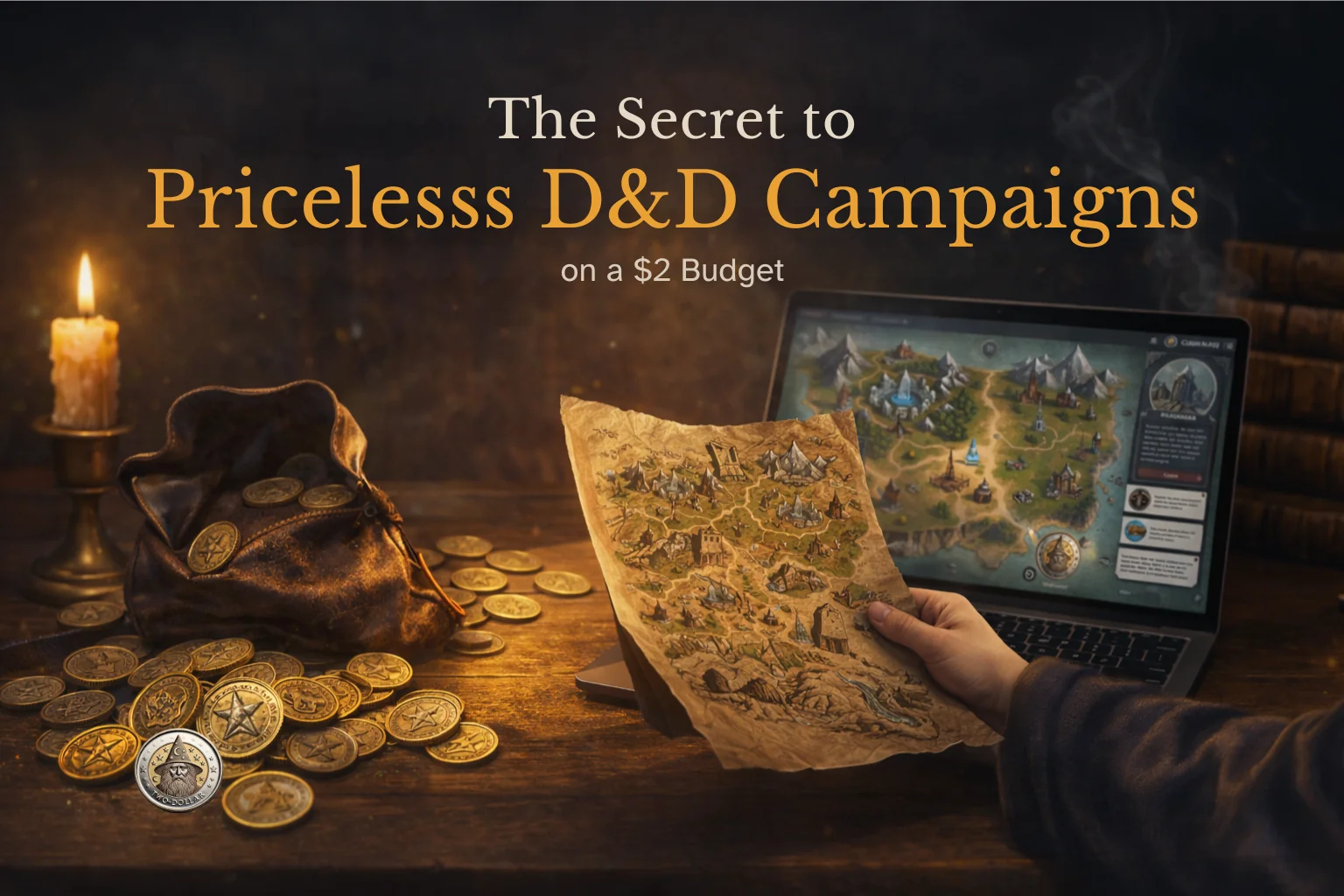
The Secret to Priceless D&D Campaigns on a $2 Budget
You've been standing in your local game store, drooling over those shiny new D&D books like they're the last slice of pizza at a party. The 2024 Player's Handbook? Fifty bucks. Dungeon Master's Guide? Another fifty. That fancy special edition with the holographic dragon on the cover? Don't even ask.
Add it up, and you're looking at dropping more cash than a Vegas weekend to roll some dice with friends.
If you've found your way here, you're probably in a similar boat. Maybe you're a student. Maybe you're saving for a house. Maybe you think it's ridiculous that running imaginary adventures for your friends requires a second mortgage.
You don't need to spend hundreds of dollars to run an epic campaign. Some of the best D&D I've ever run cost me less than a large coffee. And unlike that coffee, the memories last longer than twenty minutes.
The Two Extremes (And Why You Should Use Neither)
When it comes to running D&D, most advice pushes you toward one of two extremes. They both have problems.
Extreme #1: Buy Everything
This is the path Wizards of the Coast (well, Hasbro, let's be real about who's cashing those checks) wants you on. Buy the core books. Buy the adventure modules. Buy the special editions. Buy the minis. Buy the terrain. Buy the subscription to D&D Beyond so you can access the books you already bought in physical form.
Suddenly you've spent $500 and you're running Curse of Strahd exactly as written because, well, you paid for it. You feel obligated to use every encounter, every NPC, every carefully balanced combat. The adventure becomes a railroad because you're not going to waste that investment.
Your players start to feel it too. They make choices, and you gently (or not so gently) nudge them back onto the path. "Are you sure you want to go to the mountains? The module... I mean, uh, my carefully crafted story... really needs you to go to the castle."
Extreme #2: Homebrew Everything
Ah, the romantic dream. You'll be the next Gary Gygax! You'll create an entire world from scratch: continents, kingdoms, pantheons, magic systems, all of it birthed from your magnificent imagination.
Three months later, you've got forty pages of world-building notes, a half-finished map, seventeen gods with unpronounceable names, and zero actual adventures prepared. Your players are still waiting for Session 1 while you agonize over whether the dwarves should have a trade dispute with the gnomes or the halflings.
Burnout hits. The campaign dies before it starts. I've watched it happen to plenty of DMs, and I've caught myself heading down that road more than once.
The Happy Medium: Bargain Brew
I'm proposing a third path. I call it the Bargain Brew method.
Think of yourself not as a consumer (buying everything) or a creator (making everything). Instead, you're a creative curator. A remix artist. A DJ, but instead of mixing beats, you're mixing free and low-cost resources into campaign gold.
The Bargain Brew philosophy is simple:
-
Find the hidden gems. There's an absolute treasure trove of free, legal, high-quality D&D content out there. Complete rule systems. Adventure modules. Maps. Generators. World-building resources. Most DMs don't even know it exists.
-
Combine and customize. Take pieces from different sources. Grab a free adventure, drop it into a different setting, add NPCs from a random generator, season with your own ideas. Suddenly you've got something unique.
-
Stay flexible. Because you're not locked into expensive pre-written content, you can actually respond to what your players do. They want to go to the mountains instead of the castle? Cool. You'll find a mountain adventure. The story becomes truly collaborative.
We're uncovering hidden, low-cost genius and refining it into platinum amazingness. We're harnessing the creative energy of countless designers who've made their work freely available. We're building campaigns that are genuinely ours (and our players') without breaking the bank.
Why This Actually Works Better
The "building block" approach makes you a better DM.
When you're locked into a $50 adventure module, every player choice that goes off-script feels like a problem. But when your campaign is assembled from modular pieces (a setting from here, an adventure hook from there, NPCs you can drop in anywhere) suddenly player agency becomes a feature, not a bug.
Your rogue wants to pursue that throwaway NPC you mentioned once? Great, you'll flesh them out. Your party decides the main villain is actually kind of sympathetic and they want to negotiate? No problem. You're not married to the book's predetermined ending.
This is the magic of collaborative storytelling. If the group can work together, including the DM, all the players can create a campaign that is their specific story. That's not budget D&D. That's better D&D.
Your players will feel the difference.
The Two Dollar DM Toolkit
Here's what a budget campaign actually runs on:
A Complete (Free) Game System
You need rules, obviously. And I'm not talking about some half-baked System Reference Document that's missing everything good. I'm talking about complete, modern, fully-featured 5e-compatible rule systems that cost absolutely nothing.
The D&D 5.1 SRD is now in the Creative Commons. Free forever, legally. But it's a skeleton. For a complete experience, you've got options like Level Up: Advanced 5e (over 1,200 pages of free content), Black Flag from Kobold Press (modern 5e with quality-of-life improvements), or combining multiple sources into something that works for your table.
We'll dig deeper into choosing a system in the next post. It's a bigger topic than people realize.
World-Building Resources (Mostly Free)
Designers across the internet have released free city guides, adventure locations, and campaign settings. MT Black's Iskandar. Free previews from Fateforge. Raging Swan's village supplements. You can cobble together a rich, detailed world from these building blocks.
AI tools like ChatGPT also help generate NPCs, plot hooks, and location descriptions when you need to fill gaps. Think of it as a brainstorming partner who never gets tired.
Campaign Management (Also Free)
Fantasy Grounds has a free demo that works perfectly as an offline campaign manager, even if you're playing in person with physical dice. It tracks combat, organizes your notes, and keeps everything hyperlinked. I use it for every game now, and I haven't spent a dime.
The Glue
DMs Guild. DriveThruRPG's free section. Online generators like Donjon and Kassoon. Patreon creators with free tiers. The occasional pay-what-you-want gem where you can legitimately pay two dollars and get something amazing.
This is how you build a campaign that costs less than a fast food meal but plays like a million bucks.
What Two Dollar DM Is About
This site exists to show you exactly how this works. Tool tutorials. Resource roundups. Deep dives into free adventures. Real examples from my own campaigns. No gatekeeping, no affiliate-link spam disguised as recommendations. Honest, practical guidance for running great games on a tiny budget.
We're going to prove that the best DMs aren't the ones with the most expensive tools. They're the ones who can cobble together magic from thin air and make their players believe in it.
By the time we're done, you'll be able to create D&D adventures so epic your players will think you're some kind of Hasbro Jesus.
You'll also still be able to afford pizza for the table.
Next up: Choosing Your Free Game System: A Practical Guide to 5e Alternatives
We'll break down the actual options for running 5e-compatible games without buying the official books. What's complete? What's missing pieces? What's the right choice for your table? Plus, I'll introduce you to a little something I've been working on called Fusion 5E.
Roll high, spend low.
— The Two Dollar DM
P.S. If you want to get started right now, here are three things you can do in the next ten minutes:
-
Download the D&D 5.1 SRD (it's free and legal, and it's yours forever)
-
Bookmark Donjon (seriously, this site has saved me more prep time than I can calculate)
-
Subscribe to this blog so you don't miss the game system breakdown
P.P.S. Yeah, I know Fantasy Grounds looks intimidating. Give it twenty minutes. Once you see that combat tracker in action, you'll understand why I use it for literally every game, online AND offline. It's like having a tireless assistant DM who never forgets the rules.
Resources Mentioned
Keep Reading
Five Capital Cities for Five Dollars
Five capitals. Five distinct feels: a ruin, a bureaucracy, a mountain hold, a smuggler's port, and a court of professional flatterers. All built from free previews.
Buy It, Build It, or Steal One Island: How to Actually Get a Campaign World
You have two paths to a campaign world: take one someone already finished, or generate your own from scratch. I used neither on its own. I bought one $5 city sourcebook and stole a single island out of it.
Choosing Your Free Game System: A Practical Guide to 5e Alternatives
Not all free rulebooks are created equal. After testing Level Up A5E, Black Flag, and the official SRDs with real players, here's what actually works at the table.
The Two Dollar Philosophy: Why Constraints Make Better Games
Spending less on your hobby doesn't mean settling for less. Here's why budget constraints actually improve your games.